Do I Need HCG with TRT? A Clinician's Guide to Preserving Fertility and Hormonal

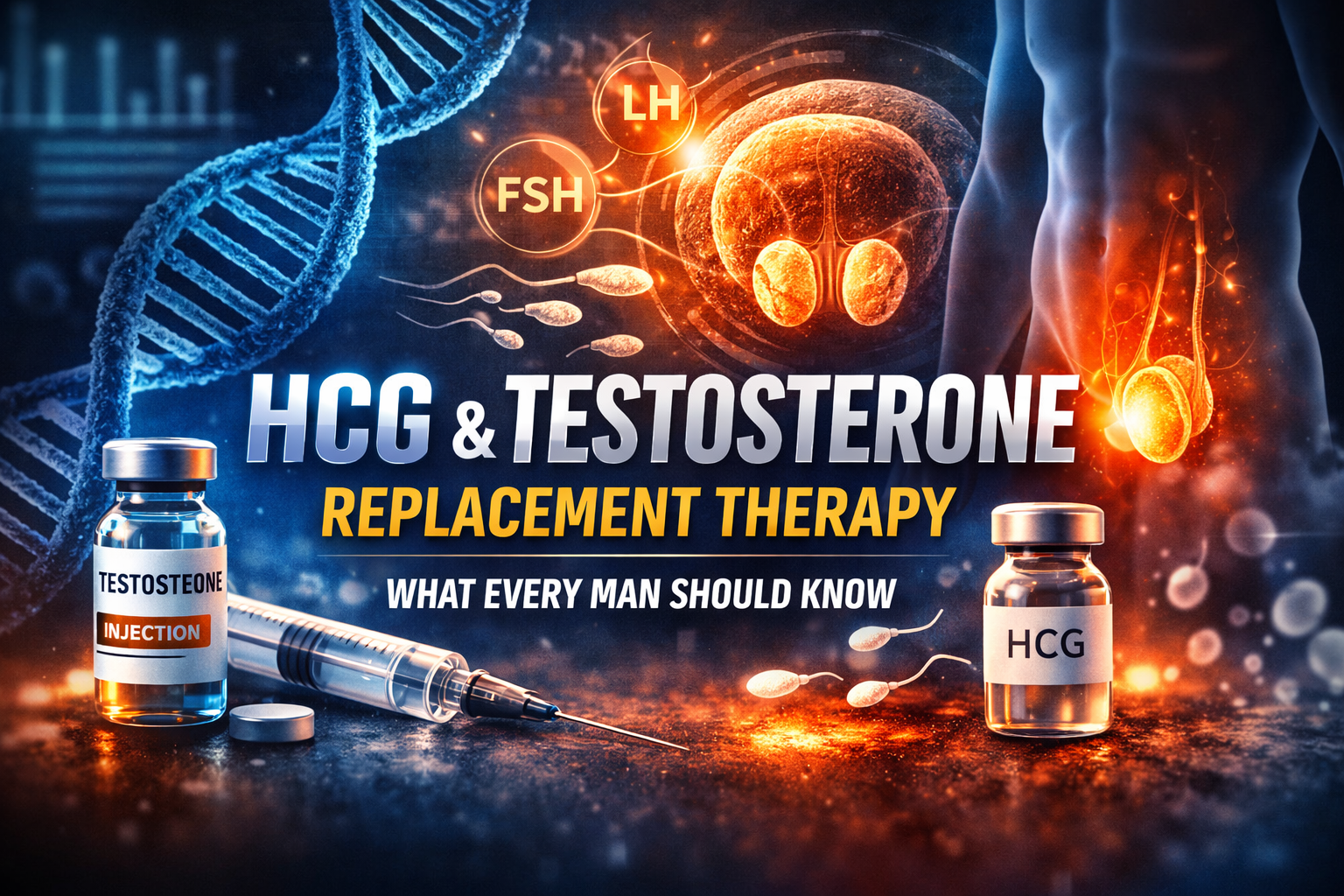
💡 HCG and Testosterone Replacement Therapy (TRT): What Every Man Should Know
Human Chorionic Gonadotropin (HCG) isn’t testosterone — but it plays a crucial role for many men on TRT. In this evidence‑based guide, we explain what HCG does, why it’s used with TRT, and how it affects fertility, hormones, and well‑being.
🧬 What Is HCG?
HCG is a hormone that mimics luteinizing hormone (LH) — the signal your brain sends to your testicles to make testosterone. Unlike TRT, which delivers testosterone externally, HCG stimulates your own testicles to keep functioning Ramasamy et al., 2025.
⚙️ How Does TRT Affect the Body?
When you begin TRT, your brain senses the high testosterone levels and reduces production of GnRH, LH, and FSH — key hormones that trigger testicular activity. As a result:
- Natural testosterone production drops
- Testicles reduce sperm production
- Testicular size can shrink significantly
This suppression is a well-documented mechanism in TRT therapy Endocrine Society, 2023.
🧠 What Does HCG Do on TRT?
HCG works by acting like LH. It binds to receptors on Leydig cells in the testes, keeping them active — maintaining intratesticular testosterone (ITT) and promoting sperm production Coviello et al., 2005.
Without HCG, TRT can reduce ITT by up to 94%. With low-dose HCG, this drop is prevented — in fact, ITT can return to near baseline or above with proper dosing Ramasamy et al., 2025.
👶 Can HCG Preserve Fertility on TRT?
Yes. This is one of the most important clinical uses of HCG.
Studies show that using low-dose HCG alongside TRT helps preserve sperm production in many men, supporting fertility during treatment Shiraishi et al., 2024.
In men planning to conceive, HCG is often the preferred add-on therapy to avoid TRT-induced infertility González & Clavijo, 2022.
📊 What Does the Evidence Say?
Key Findings:
- HCG with TRT preserves fertility in hypogonadal men and maintains semen quality Shiraishi et al., 2024.
- Intratesticular testosterone is preserved or restored with proper HCG co-administration Coviello et al., 2005.
- HCG monotherapy can raise testosterone levels effectively in men recovering from TRT or anabolic steroid use González & Clavijo, 2022.
These studies reflect both longstanding research and the latest clinical reviews in male hormone therapy.
🔬 How Is HCG Administered?
HCG is typically injected 2–3 times per week in doses ranging from 250 IU to 1,500 IU, depending on:
- Fertility goals
- Baseline hormone levels
- Co-use with testosterone
Protocols may vary, but patient-specific plans are standard best practice Endocrine Society, 2023.
📍 Who Should Consider HCG?
HCG is especially recommended for men who:
- Want to preserve fertility while on TRT
- Are concerned about testicular shrinkage
- Are planning for children in the future
- Prefer to retain some natural testosterone production
For other patients, it may not be essential — but for fertility preservation, it’s the gold standard Shiraishi et al., 2024.
⚠️ Side Effects and Considerations
HCG is generally well tolerated but may cause:
- Mild fluid retention
- Acne or oily skin
- Temporary emotional fluctuations
These side effects are less common than those from high-dose TRT alone, but monitoring is essential González & Clavijo, 2022.
🧠 Summary
- TRT can suppress natural testosterone and sperm production.
- HCG mimics LH to keep the testes active and preserve function.
- Evidence shows HCG helps maintain fertility and intratesticular testosterone.
- HCG dosing is tailored and should be supervised by a medical team.
- Combining TRT and HCG may help improve libido, mood, fertility, and testicular health.
📲 Want to know if HCG should be part of your TRT plan?
At Eden Clinic, we’ll assess your goals, symptoms, and labs — and design a treatment that supports not just hormones, but your long-term health and future.
Talk to an Eden Clinic doctor
This article is general information, not medical advice. If you would like your own symptoms, results or treatment options reviewed, our doctors offer private consultations in Plymouth and online.
Concerned about low testosterone?
Low testosterone is common, under-diagnosed, and treatable. Dr Angela Servis reviews every set of results herself, and the first step is a proper blood test. Questions? Call the clinic on 0333 335 6414.